

The structure and design of the Commonwealth war cemeteries and memorials played an important part from the very beginning of their creation. Except for a few exceptions, due to local geological conditions, all of the cemeteries follow the same design globally so that they may be easily recognized and distinguished from war graves of other countries or groups.
Sir Frederic Kenyon who described his vision of the cemeteries in 1918 said this:
“The general appearance of a British cemetery will be that of an enclosure with plots of grass or flowers (or both) separated by paths of varying size, and set with orderly rows of headstones, uniform in height and width. Shrubs and trees will be arranged in various places, sometimes as clumps at the junctions of ways, sometimes as avenues along the sides of the principal paths, sometimes around the borders of the cemetery. The graves will, wherever possible, face towards the east, and at the eastern end of the cemetery will be a great altar stone, raised upon broad steps, and bearing some brief and appropriate phrase or text. Either over the stone, or elsewhere in the cemetery, will be a small building, where visitors may gather for shelter or for worship, and where the register of the graves will be kept. And at some prominent spot will rise the Cross, as the symbol of the Christian faith and of the self-sacrifice of the men who now lie beneath its shadow.”

Perth (China Wall) Cemetery in Belgium
Typically the cemeteries are surrounded by a low wall or hedge with a wrought-iron gate at the entrance. Notably, for cemeteries in France and Belgium, a land tablet is found near the entrance to identify that the grounds have been provided by the French or Belgian government.
All but the very smallest cemeteries also contain a register with an inventory of the burials, a plan of the plots and rows, and a basic history of the cemetery. These registers are found in metal cupboards marked with a cross found near the entrance or in a shelter within the cemetery.
The grounds are covered in grass with a floral border around the headstones (except in drier climates) and were designed as such to make the cemetery feel like a traditional walled garden where visitors could feel a sense of peace instead of traditionally bleak graveyards.
This post may contain affiliate links. Please read our full disclosure policy here.
TABLE OF CONTENTS
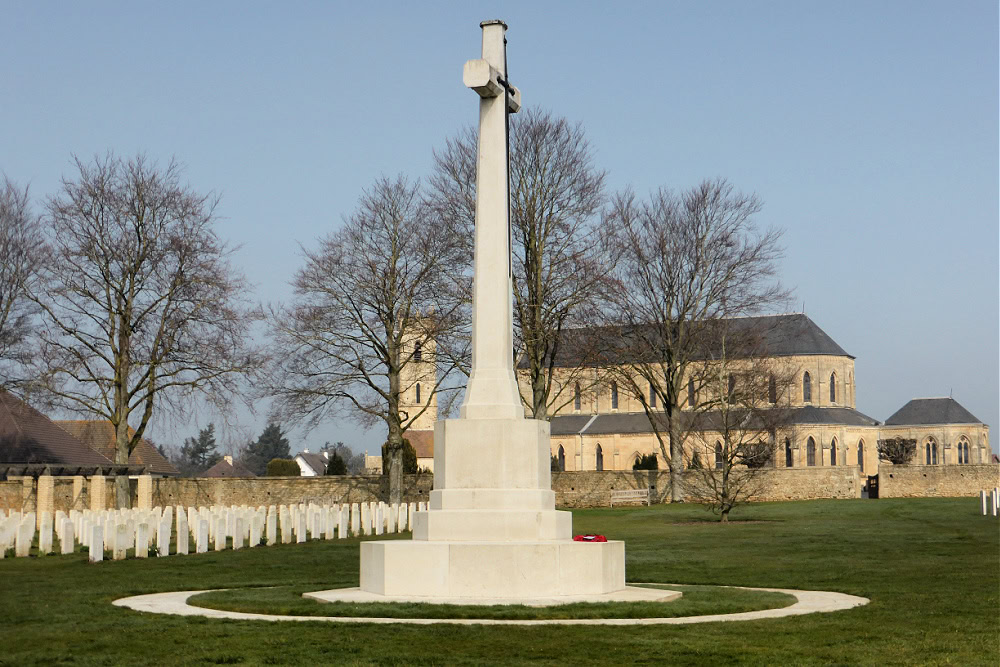
Designed by Sir Reginald Blomfield, the Cross of Sacrifice is a symbol of the selflessness displayed by those commemorated in each cemetery and represents the denominations of all Christians. On each one is a downward-facing bronze sword that symbolizes that the battle has been fought and those that gave their lives are now mourned.
In order not to overshadow the gravestones a Cross of Sacrifice is only placed in those cemeteries with more than 40 graves. In cemeteries with a majority of non-Christians buried there is no cross, but instead, they may have another symbol of the culture of the majority of the soldiers such as a magnificent pine tree representing longevity and endurance as found in the Chinese cemetery at Noyelles-sur-Mer in France.

Cross of Sacrifice in Becklingen War Cemetery in Germany
The Stone of Remembrance was designed by an architect Edwin Lutyens and expresses the idea of eternity. It can be found in each cemetery that has more than 1000 graves and each one bears the words “Their Name Liveth for Evermore” which was chosen by Rudyard Kipling from the Old Testament.
Although the words are from the Bible, the Stone of Remembrance was designed to be a non-Christian memorial as a sign of respect for the diversity of the 1.7 million commemorated. Unlike other religious symbols, it is meant to represent everyone. Their bodies are buried in peace and their name liveth forevermore.

Stone of Remembrance in Bayeux War Cemetery in France
READ MORE: World War II Cemeteries in Normandy, France
On almost all headstones is a cross, whether wide or narrow (depending on the country and regiment of the soldier), which shows the faith of those fallen.
There are also some stones that bear the Star of David to mark the graves of Jewish casualties, and some bear no religious symbol at all at the request of some families.

Example of headstones in Ancona War Cemetery in Italy (this is actually the grave of my great-uncle)
EMBLEMS AND PERSONAL DETAILS
All British headstones bear the regimental badges (including those of Irish regiments) and the others are marked with their respective national emblem, such as the maple leaf on Canadian headstones, shown in the images above and below.
Each headstone is marked at the top with the soldier’s name, number, unit, date of death and, often, his age. Preceding his name is his rank or Private if he was in the infantry, Gunner if he was an artilleryman, Sapper if he was with the engineers, and so on.
Sadly many bodies could not be identified at all and bear the inscription “A Soldier of the Great War, Known Unto God” that was also developed by Rudyard Kipling. If they could be partially identified then the headstone carries the additional known information.
Where applicable the soldier’s decorations, such as the Military Medal and Distinguished Conduct Medal, follow the soldier’s name on the stone.

Gravestones of unknown soldiers at Tyne Cot Cemetery in Belgium
EPITAPH
Soldier’s families could choose an epitaph to be added to the bottom of the headstone. Many chose lines from poems or the Bible, while others chose more personal messages to show their pride and love.
Interestingly Australian headstones have the highest ratio of epitaphs yet New Zealand headstones contain none.
When a soldier is known to be buried in a particular cemetery but the exact location of his grave can not be determined, he is commemorated by a “Special Memorial”. His name will appear on this stone only, and not on a Memorial to the Missing.
Engraved above his name will be one of the following inscriptions:
“Believed to be”
“Believed to be buried in this cemetery”
“Known to be buried in this cemetery”
“To the memory of”
For those soldiers where there is no known grave, his name is inscribed on a “Memorial to the Missing”. such as those at the Menin Gate and Tyne Cot.

Memorial at Rimini Gurkha War Cemetery in Italy
To view information about each of the 23,000 cemeteries and memorials maintained by the Commonwealth War Graves Commission you can visit their website and search their databases for particular cemeteries or soldiers.
Related Posts



Thanks for reading!
I’d love to hear your thoughts or your own travel stories in the comments. I read every one and enjoy chatting with fellow travellers.
14 Comments
Submit a Comment
Some of the links in the post above are affiliate links. This means if you click on the link and purchase the item, we will receive an affiliate commission but this does not affect the price to you. Please read our full disclosure policy here.
WHERE ARE WE NOW?
At home in beautiful Nova Scotia, Canada.

UPCOMING ADVENTURES
Spring 2026 – Norwegian Fjords Cruise, Prague City Break, and Eastern Europe River Cruise
Who designed the headstones ?
Hi Alan,
The headstones were designed by a committee, so no one person was responsible, though the final design may have been proposed, or something very similar, by Edwin Lutyens. The font used on the headstones was created by Leslie MacDonald Gill.
I have occasionally seen a CWGC headstone in a Welsh cemetery made from slate rather than the usual stone. However, I’ve never seen a headstone inscription in Welsh rather than English. Was this permitted? if so, do you know of any surviving examples? Thanks.
Hi Peter,
There was a policy of using local materials for headstones, hence slate would have been a good choice for Wales. We aren’t sure whether these headstones will be replaced with the Portland Stone that is now used across most cemeteries. I don’t recall ever seeing a headstone with a Welsh inscription either, would be interested to know if any exist so we could visit!
Can you please tell me the origin of the continual line of the top of the headstones compared to the the headstones with the ‘shoulder’ groves on either side at the top?
Hi Colin,
The headstones which are not the “standard” shape are not official CWGC headstones. Only soldiers who died in or shortly after either of the two world wars are eligible for the CWGC headstone and so similar headstones are sometimes purchased privately for other military graves, whether they died from conflict or of natural causes.
Hope that helps and thanks for your interest.
Regards,
Lee & Stacey
The name of the architect who designed the Stone of Remembrance is EDWIN LUTYENS.
Hi Ian,
Thank you for the correction, we have updated the post to correct the mistake in the name.
These places are amazing and well worth a visit in any country. My uncle is in a small cemetery in Argenta Gap, Italy. Only 2 gardeners have ever looked after it. Adolpho, the current gardener and his dad after the war. My nan, mum, sister and now myself have visited continuously since 1946. Such a wonderful initiative, born out of gratitude and respect, that completely got it right from the original conception.
Hi Lorraine, we couldn’t agree more, from the large cemeteries to the tiniest, they are always immaculately kept and moving places to visit. We are so grateful to the people who work to keep them looking so beautiful.
Really interesting (and moving) information. However it would be helpful to know also whether all the graves are mingled, or whether there are different sections for different faiths; the implication drawn from the website is that there is no separation, but I should be grateful to have this confirmed ?
Hi Rosemary,
It depends on the cemetery, I have seen a cemetery where all the graves were aligned, except for one corner, where Muslim soldiers graves were angled so they faced Mecca for example. But in general, the graves are intermingled in my experience, you will find a grave with the Star of David on it, right next to a grave with a cross on it.
Hello, can I get a helping hand from you? My point is that I lost my uncle a second time in World War II, and there is no search for him, and in no way did he find an address to discuss anything
Hi, Sorry, but that is not something we are able to help with. We are not affiliated with the Commonwealth War Graves Commission, we just respect their excellent work and wanted to write some articles about them. Best of luck with your research into your Uncle.